
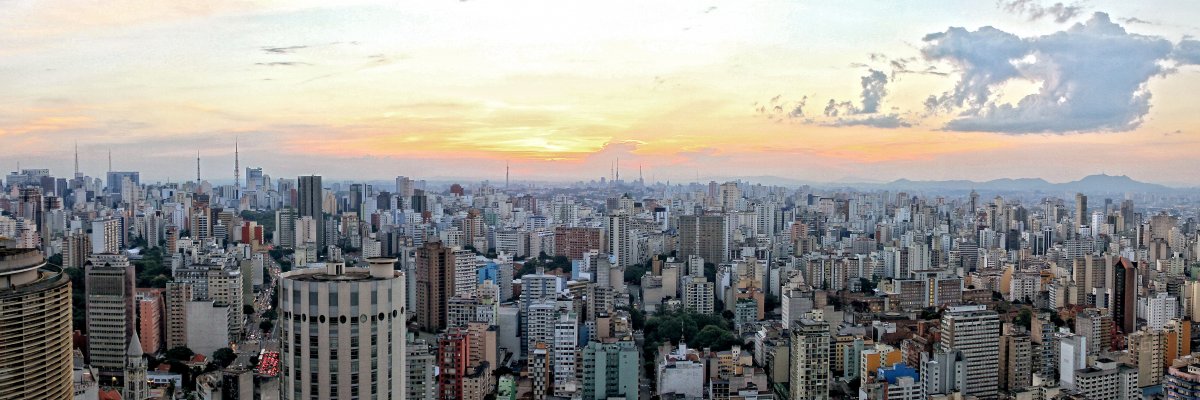
- Location: Southeastern Brazil, capital of São Paulo state; the economic engine of the continent.
- Nickname: "Sampa" or "Cidade da Garoa" (City of Drizzle).
- Population: 12.3 million (city), 22 million (metro area).
- Language: Brazilian Portuguese.
- Currency: Brazilian Real (BRL).
- Climate: Subtropical; warm summers (Dec-Mar) and mild, often grey winters (Jun-Sep).
- Landmarks: Paulista Avenue, Ibirapuera Park, MASP (Museum of Art), and the Municipal Market.
- Culture: A massive melting pot of global influences; defined by intense work ethics, world-class gastronomy, and a relentless urban pace.
- Must-Try Foods: São Paulo-style pizza, Mortadella sandwich, and Coxinha.
- Transport: Extensive Metro network, buses, Uber, and two major airports (GRU & CGH).
- Safety: High urban awareness required; avoid isolated areas in the city center at night and stay alert in crowded Metro stations.
You could spend your late afternoon at Sunset Square (Praça Por do Sol) in Alto de Pinheiros.
Engage with the local Brazilians and get more than just a tourist point of view.
Perhaps, head across the river to "Universidade de Säo Paulo" in the Bútanta neighbourhood.
In Säo Paulo almost everything is cheaper once you cross the river. ;)
Try exploring the upper side of Vila Madalena.
The hills of Pompéia will keep you strong.
Great eating places and bar life while getting a workout.
Visit the hidden alley bars around the area.
Do not worry, the locals already know you are there. ;)
If you have already come this far go for an enjoyable place with homemade IPAs, and incredible meats at Quintal da Imperatriz
The quest for a happy ending in Brazil
The preface of a dream part 2
São Paulo. The largest city of the Southern hemisphere
One year had passed since my first visit to Brazil.
I came back with confidence in having some knowledge of what this nation is about, without knowing my edification had just begun.
My earlier trip had provided me with a light taste of the culture and different regions with locations of interest for the future as I was dipping my curiosity into a new country.
I came to Brazil to pursue my dream with the hope of building a little family-run place somewhere along those 7000 kilometres of coastline. Not to live in Sao Paulo.
Initially, the big city was supposed to be a temporary thing.
A place to integrate while learning the language and building contacts.
Learn how to teach English as a backup plan in case the paradise idea fails.
Parque Villa Lobos (Park Villa Lobos)

I flew into the city of São Paulo, something that seemed monstrous at the time.
What was I doing here, in a gigantic city where I had a limited tongue of communication!?
I got myself situated at a hostel in the Pinheiros district, a central - popular happening point for most social activities.
This hostel was also where I met my future wife. :)
Despite all the stories and presumptions we sometimes have or hear about Gringos that go to Brazil, I managed to marry the best and most beautiful woman - without a doubt. :)
I only spent a short period on my first time here.
The city was more or less just a starting point with an anchor for new travel events and to look up contacts that I had already established during the previous year.
Little did I know that, a few years later, São Paulo would become my daily work ground and home.
I re-visited Rio de Janeiro, Arraial DAjuda in Bahia and finally Joáo Pessoa in Paraíba.
I decided to end my trip, this time in the south region of Brazil and head to the island of Florianópolis, in the state of Santa Catarina.
Florianopólis (Floripa)
A paradise island in the South of Brazil, with more than 80 spread out beaches, where eight are in perfect reach of tourism.
It is overpopulated during the Brazilian summer season from December to mid-Martz and overpriced since most inhabitants have to make do throughout the entire year.
Visitors happily pay almost anything for what is considered a unique experience to a heavenly island that has everything and is
statistically recorded as a top living-life quality area of Brazil.
Florianópolis (Floripa) is a small place in terms of Brazilian scale, but with a developing impact within IT that puts a mark while joining hands with tourism to keep a healthy economically flow.
IT combined with tourism is a clever choice, no doubt.
The Island, however, has a limited capacity for growth to compensate for the yearly visitors. There are too many to accommodate.
The traffic issue in Florianópolis is well known.
An Island can only expand to what it has available.
With only one main road through the entire Island gives tremendous flow problems without being able to expand.
They do not have the option to create another road running through it.
Exited any gossip media, you might head here on a wing
outside of the Brazilian summer without knowing better and discover contrasting beauty with a magnificent mix and calmness.
TO BE CONTINUED...
Leave a Comment
Comments